
Offshore oil and gas safety
There are European rules introduced to prevent the risk of accidents on offshore mining platforms and, eventually, to respond.
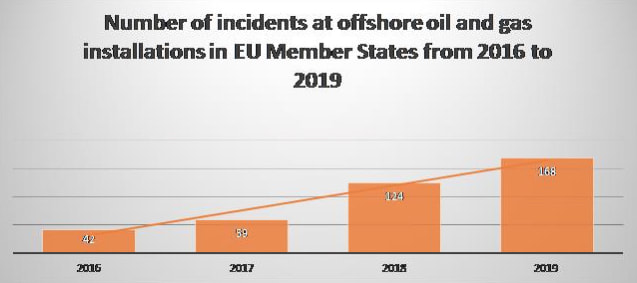
|
A large part of Europe's oil and gas production takes place offshore. With 543 installations in the EU, the number of installations decreased in 2019 compared to the preceding year (556 in 2018). However, the level of overall oil and gas production slightly increased from 112 217 ktoe of oil equivalent in 2018 to 120 340 ktoe of oil equivalent in 2019.. Given the EU's high energy demand and expected to be increasing, these operations help to ensure a secure energy supply. There is therefore a need for comprehensive safety measures, because an accident in one country can cause environmental and economic damage to its neighbors as well. For this reason, Directive 2013/30/EU was introduced on the safety of offshore oil and gas operations. It establishes a set of rules to help prevent accidents as well as to respond promptly and efficiently if one occurs:
In 2015, the European Commission published a Report COM/2015/0422 and a Staff Working Document SWD(2015)167 on liability and compensation in the case of offshore in Europe. These documents examine how physical harm, property damage and economic loss are handled, as well as the financial security tools that would cover such damages. They are based on the results of a study conducted for the Commission which was published in 2014. Annual reports by member states The Regulation (EU) 2018/1999 asks Member States to report annually to the Commission, as part of the annual reporting referred to in Article 26 the information specified in point 3, of Annex IX. Member State competent authorities work together through the European Union Offshore Oil and Gas Authority Group (EUOAG) to share best practices and improve standards. To further promote offshore safety, the European Commission works with its international partners to implement the highest safety standards worldwide. In addition, since 2016 the Commission has published an annual report on the safety of EU offshore oil and gas operations, the latest of which covers 2019. Evaluation of the EU Directive In 2020 the Commission provided a report to the European Parliament and the Council, along with a Staff Working Document (SWD) with additional background information, which outlines the implementing of the directive. In 2021, the EU Commission published an Annual Report COM/2021/585 final on the Safety of Offshore Oil and Gas Operations in the EU. |
Click to read the last consolidated version
Click to read
Click to read
|